The Making of the Book
A finished book leaves much of its making out of view. These pages offer a glimpse of the study, thought, and conversation behind Hidden Gold and Difficult Questions.
Over the years, I led several Davanloo study groups in which colleagues and I read his cases closely and discussed them together. Leading these groups motivated me to take notes and write study guides. Those notes and guides eventually grew into the latter half of this book. I am grateful to everyone who participated: their questions, observations, and perspectives inspired me and enriched the process.
In the summer and fall of 2026, I wrote the first half of the book, developing its conceptual spine. Much of the work also involved integrating these new chapters with the case studies, so that the two halves formed a coherent whole. The book thus brought together years of close reading and discussion with a more concentrated effort to articulate an understanding of Davanloo’s work that I had been developing since 2012.
Sharing the manuscript brought another kind of conversation. A passage that seemed clear to me could leave a reader searching for an example. A distinction could need more room. Sometimes a brief comment revealed a difficulty I had read past many times. Sometimes a reader recognized precisely what I had hoped to convey. Their responses helped me see both where the writing held and where further work was needed.
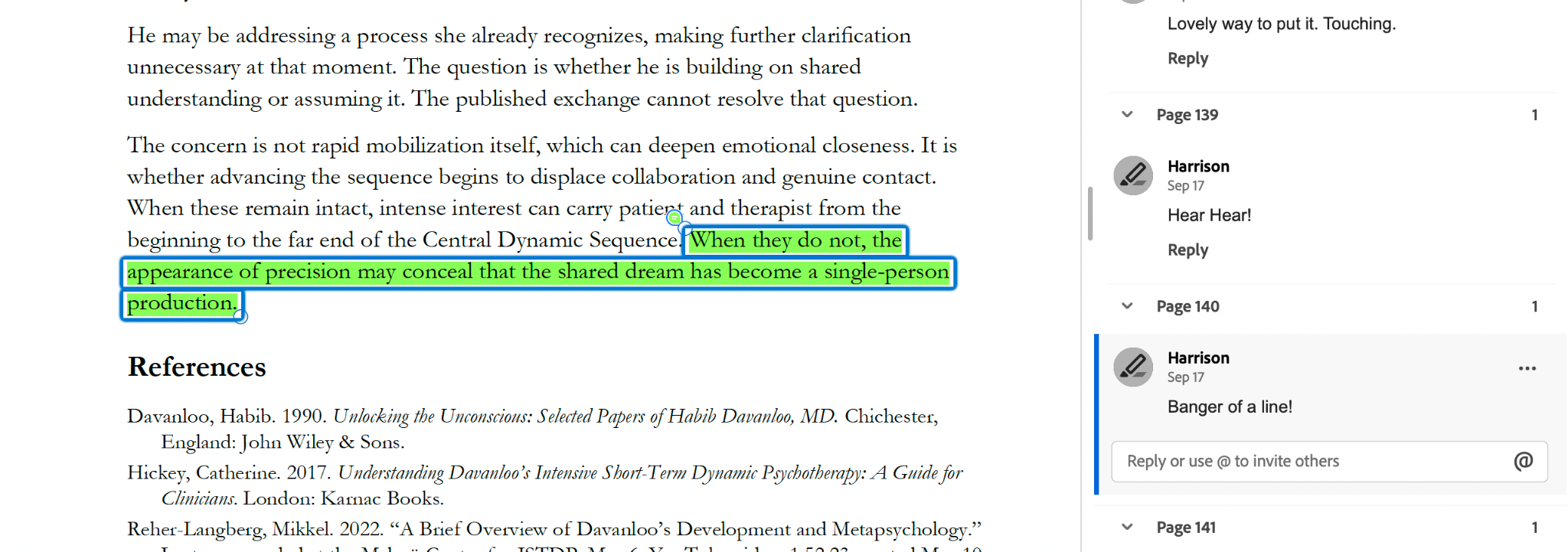
The manuscript images below offer a glimpse of that process while sampling the book itself. They come from different stages of the manuscript, so some wording differs from the published version. I have included them to share the exchanges behind the finished pages—and to acknowledge the careful readers who helped me bring them into focus. Further down, conversations with Eric Schneider and Jon Anders Lied explore finding my own voice and helping readers follow the argument. The book’s acknowledgments are available at the end of this page.
Passages and conversations in the margins
For the clearest view of the manuscript passages and editorial comments, I recommend viewing this page on a computer. You can also select any screenshot to open it at full size and zoom in.
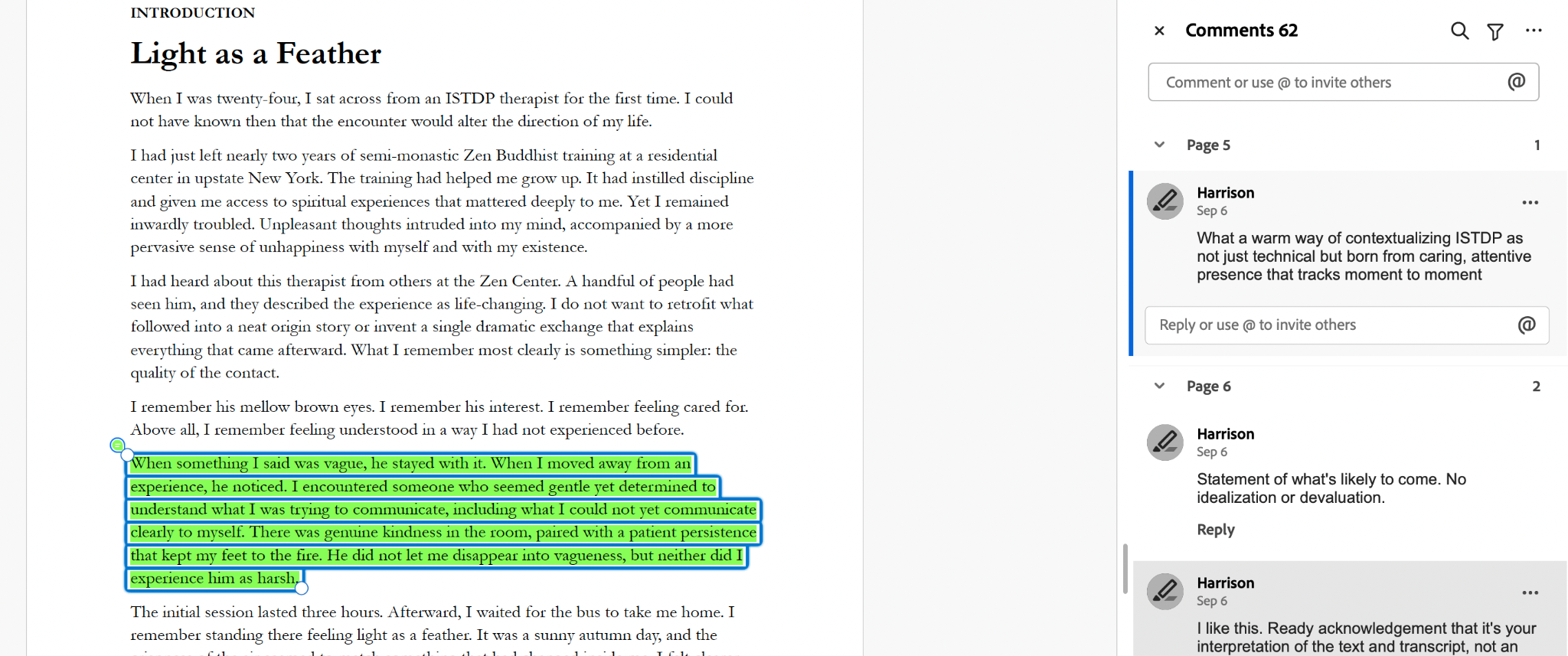
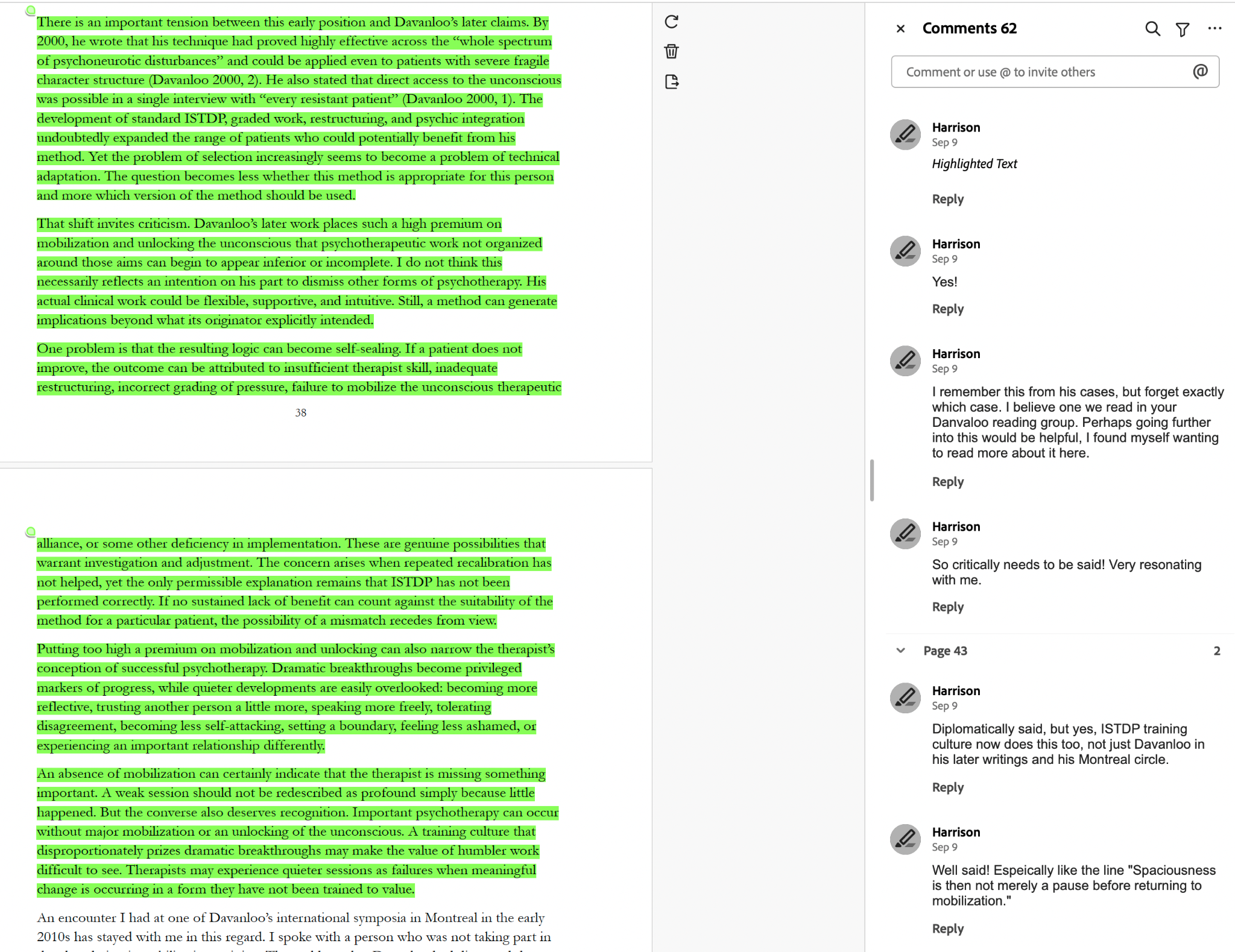
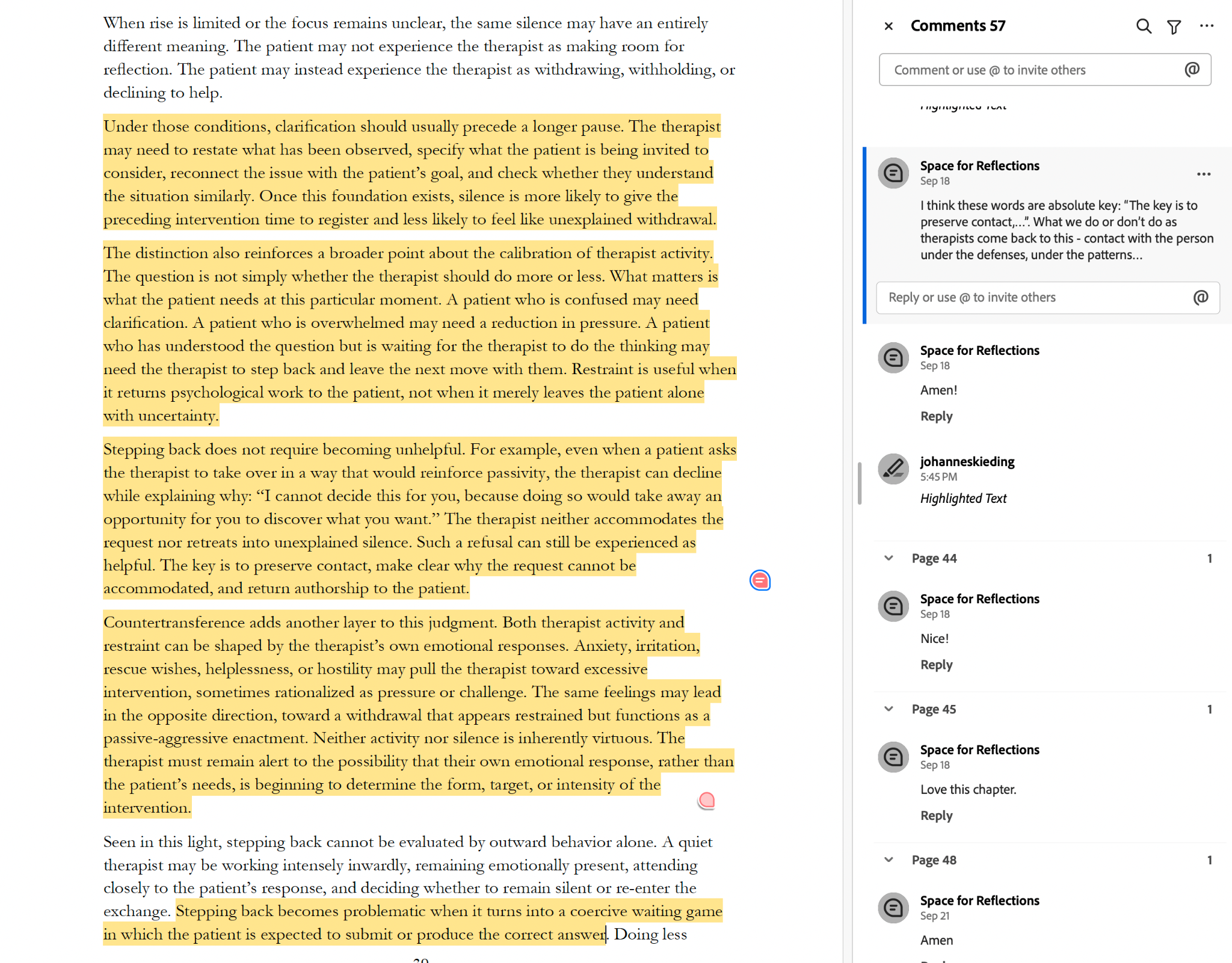
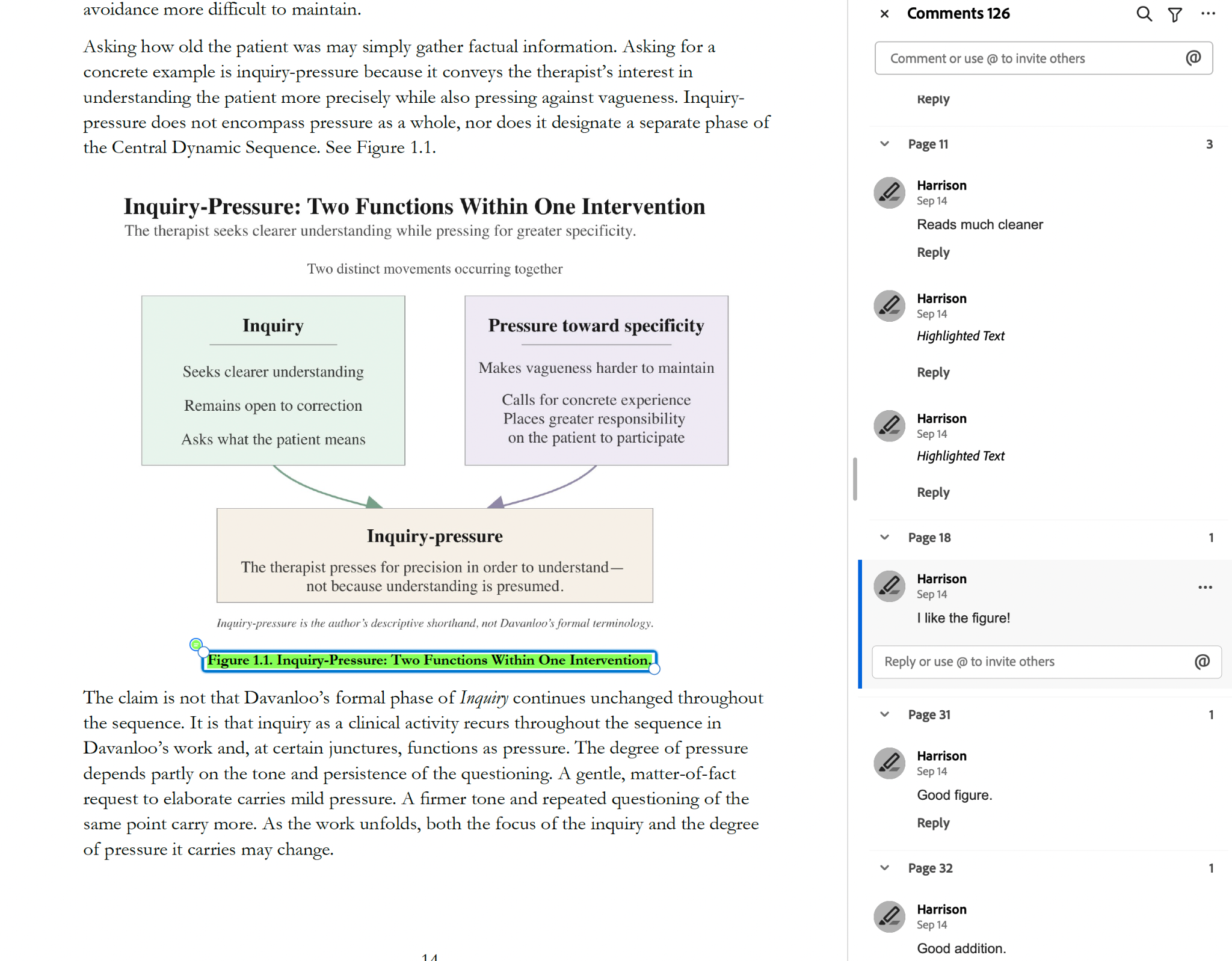
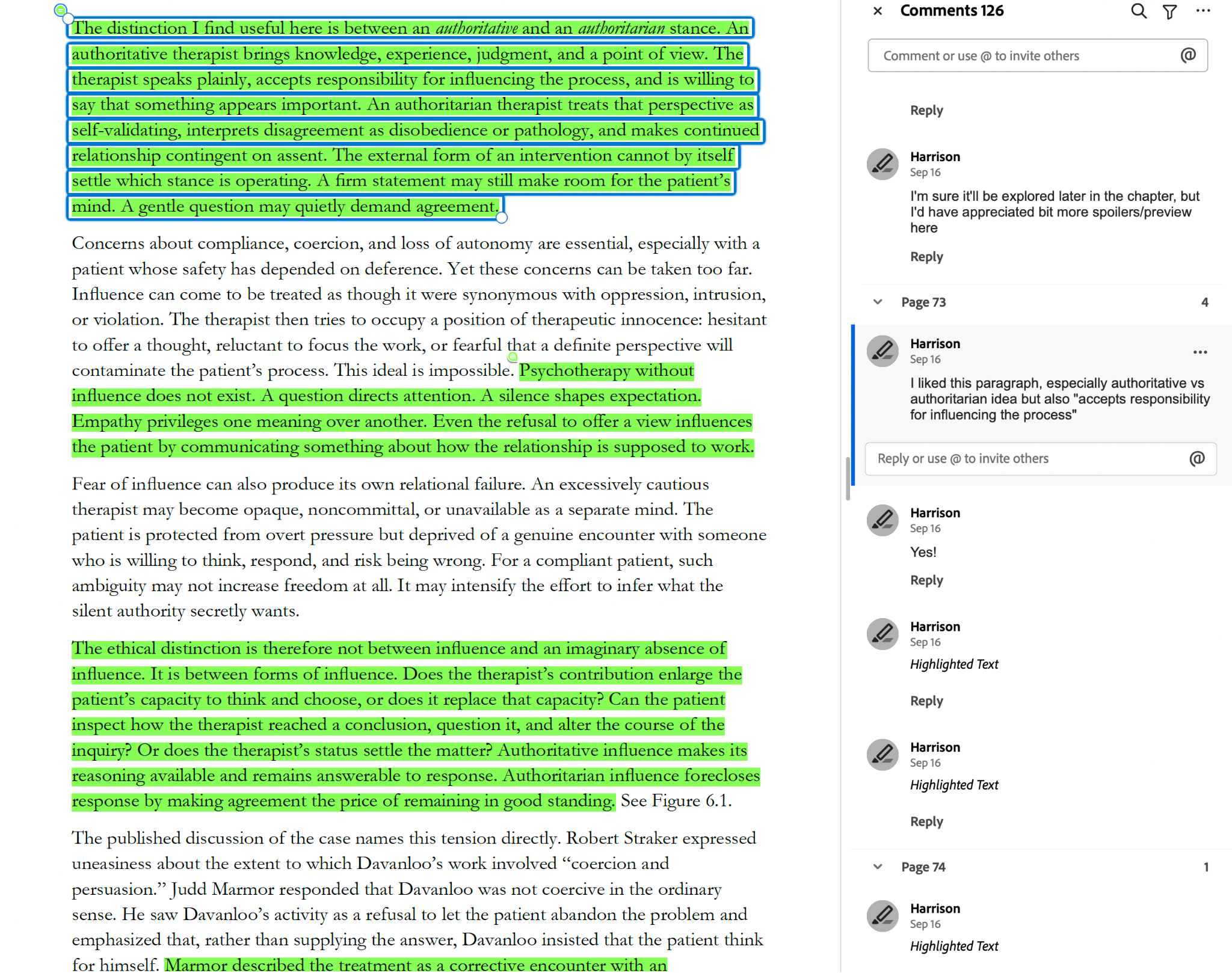
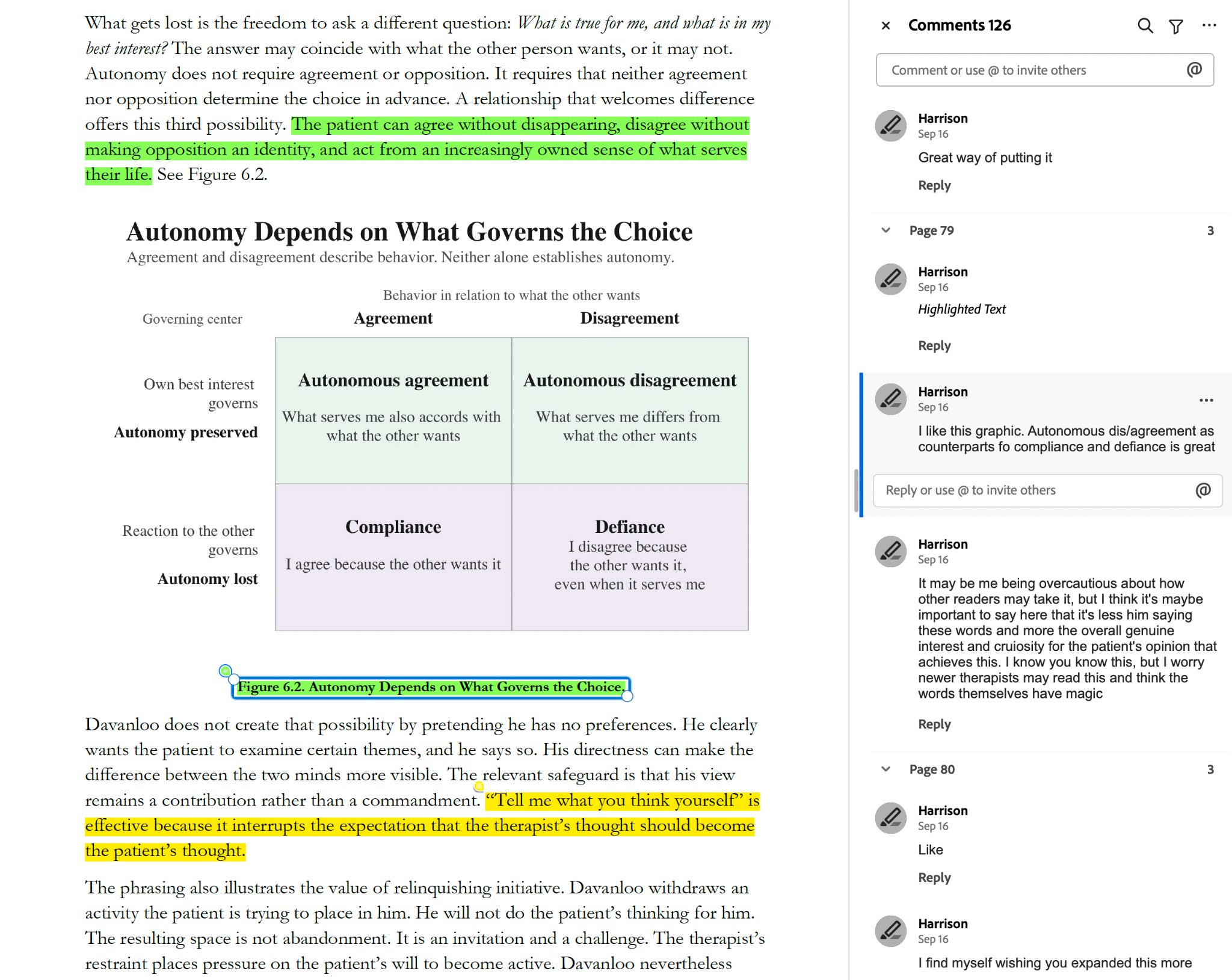
A draft of the concluding chapter, with Michaela Lonning’s feedback. She welcomed the passage while pointing out that the comparison needed a clearer introduction—a small change that helped readers follow the argument.
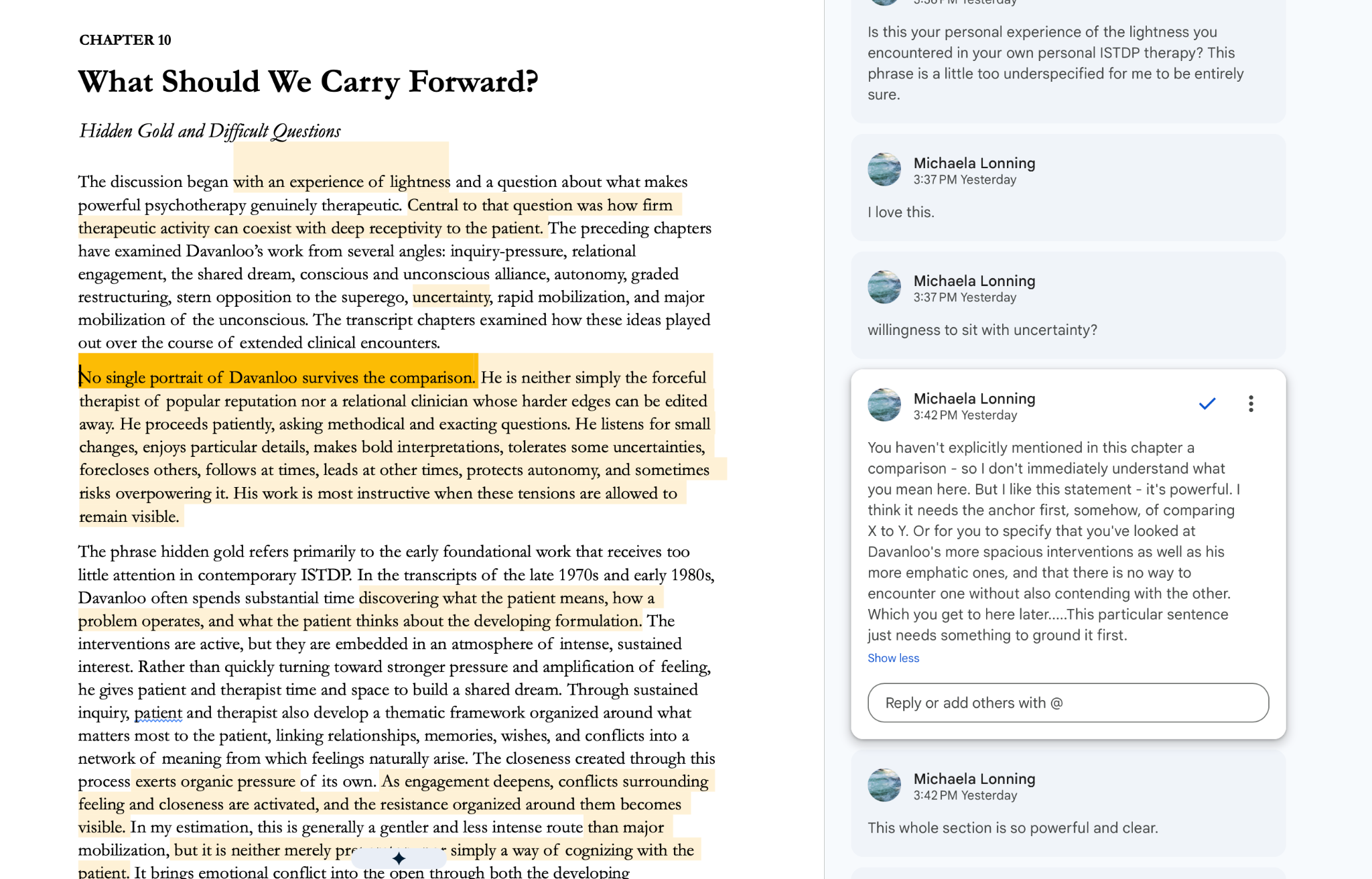
Making Room for My Own Voice
A conversation with Eric Schneider about bringing more of my own experience and perspective into the book.
Helping Readers Find Their Way
A conversation with Jon Anders Lied about giving the book more subheadings. His suggestion invited me to consider how the structure of a chapter could help readers follow the argument, recognize a shift in focus, and find their way back to an idea.
Acknowledgments
The acknowledgments below appear in the book. They express my gratitude to the people whose work, encouragement, and careful reading helped me bring it into being.
Select the page to open it at full size and zoom in.
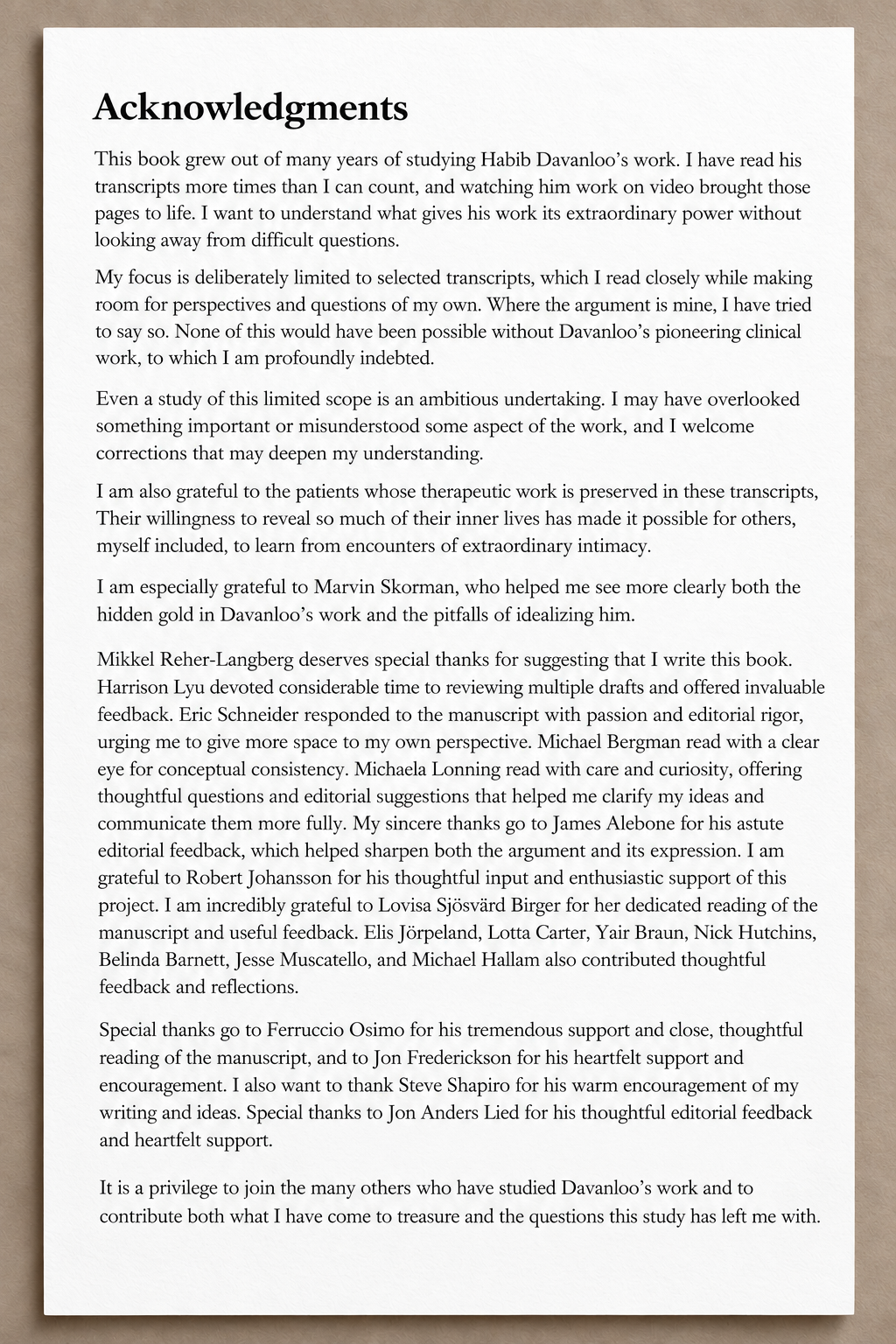
This book grew out of many years of studying Habib Davanloo’s work. I have read his transcripts more times than I can count, and watching him work on video brought those pages to life. I want to understand what gives his work its extraordinary power without looking away from difficult questions.
My focus is deliberately limited to selected transcripts, which I read closely while making room for perspectives and questions of my own. Where the argument is mine, I have tried to say so. None of this would have been possible without Davanloo’s pioneering clinical work, to which I am profoundly indebted.
Even a study of this limited scope is an ambitious undertaking. I may have overlooked something important or misunderstood some aspect of the work, and I welcome corrections that may deepen my understanding.
I am also grateful to the patients whose therapeutic work is preserved in these transcripts. Their willingness to reveal so much of their inner lives has made it possible for others, myself included, to learn from encounters of extraordinary intimacy.
I am especially grateful to Marvin Skorman, who helped me see more clearly both the hidden gold in Davanloo’s work and the pitfalls of idealizing him.
Mikkel Reher-Langberg deserves special thanks for suggesting that I write this book. Harrison Lyu devoted considerable time to reviewing multiple drafts and offered invaluable feedback. Eric Schneider responded to the manuscript with passion and editorial rigor, urging me to give more space to my own perspective. Michael Bergman read with a clear eye for conceptual consistency. Michaela Lonning read with care and curiosity, offering thoughtful questions and editorial suggestions that helped me clarify my ideas and communicate them more fully. My sincere thanks go to James Alebone for his astute editorial feedback, which helped sharpen both the argument and its expression. I am grateful to Robert Johansson for his thoughtful input and enthusiastic support of this project. I am incredibly grateful to Lovisa Sjösvärd Birger for her dedicated reading of the manuscript and useful feedback. Elis Jörpeland, Lotta Carter, Yair Braun, Nick Hutchins, Belinda Barnett, Jesse Muscatello, and Michael Hallam also contributed thoughtful feedback and reflections.
Special thanks go to Ferruccio Osimo for his tremendous support and close, thoughtful reading of the manuscript, and to Jon Frederickson for his heartfelt support and encouragement. I also want to thank Steve Shapiro for his warm encouragement of my writing and ideas. Special thanks to Jon Anders Lied for his thoughtful editorial feedback and heartfelt support.
It is a privilege to join the many others who have studied Davanloo’s work and to contribute both what I have come to treasure and the questions this study has left me with.